
10 Digital Marketing Agency Growth Statistics, Trends, and Projections

As businesses increase their online marketing efforts and invest in more specialized services, the digital marketing industry is set for exponential growth.
At Agency Designs, we’ve gathered 10 digital marketing agency growth statistics that reveal how fast the industry is growing and key revenue trends and service shifts for digital marketing agencies looking to improve operations and scale.
Digital Marketing Agency Growth Statistics: Market Size, Revenue, Agency Size, Services, and Job Growth
1. The global digital marketing agency market reached $6.32 billion in 2024—and is projected to more than triple by 2033
The market size is projected to reach $9.45 billion by 2027, growing at a 14.32% CAGR (compound annual growth rate). By 2033 the market value is expected to skyrocket to $21.09 billion.
Sources: Stripe, Digital Agency Network, Hosted.
2. Average annual revenue for a small digital marketing agency has grown to $200,000—while large agencies now average $10 million
Digital marketing agency revenue varies widely by size and specialization, whether it’s a small agency that focuses on local or niche markets, a medium-sized agency that centers on regional or industry-specific markets, or a large agency or enterprise focusing on national or global markets.
- Small agencies with fewer than 10 employees: $250K–$500K/year
- Medium agencies with 10-50 employees: $500K–$2M
- Large agencies with 50-100: $2M–$5M
- Enterprises with more than 100 employees: $5M–$10M+
Agencies specializing in high-demand areas like artificial intelligence, search engine optimization (SEO), or e-commerce often generate more revenue.
Here’s a breakdown of average revenues from specific revenue streams, as of July 2025:
- Project-based: Based on scope and complexity, fees range between $1,000 and $50K+
- Retainer-based: Depending on the services and delivery frequency, monthly fees average $1,000 to $10K
- Performance-based: Based on metrics like lead generation or sales, monthly fees can range from $500 to $5,000+
Source:
Bluegift.
3. Average revenue per employee at a digital marketing agency is $140,000
However, revenue per employee can range from $50,000 to $500,000+ depending on agency size, digital marketing services offered, location, and industry focus:
- Small agencies with fewer than 10 employees: $25K–$50K/year
- Medium agencies with 10-50 employees: $50K–$100K
- Large agencies with 50-100: $100K–$200K
- Enterprises with more than 100 employees: $200K–$500K+
Source:
Bluegift.
New 4. The share of large and mid-size digital agencies is growing—12% now have more than 50 full-time employees
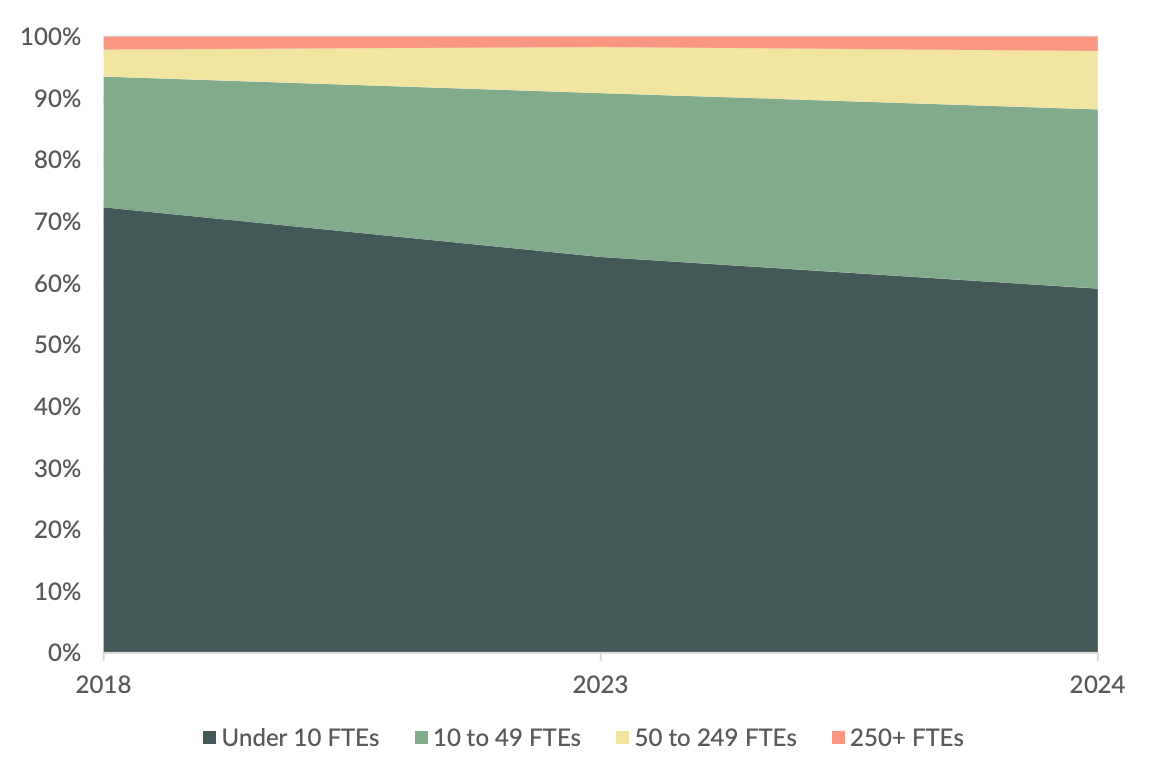
According to the 2025 Digital Agency Industry Report from Promethean Research, the average size of a digital agency (including marketing, development, or design agencies) has changed since 2018.
While most agencies still have fewer than 10 full-time employees, digital marketing agency growth statistics show a significant growth in the segment with 10 to 49 full-time employees.
Source:
Promethean Research.
5. SEO, digital strategy, and AI-related were the top-growing digital marketing agency services from 2023 to 2025
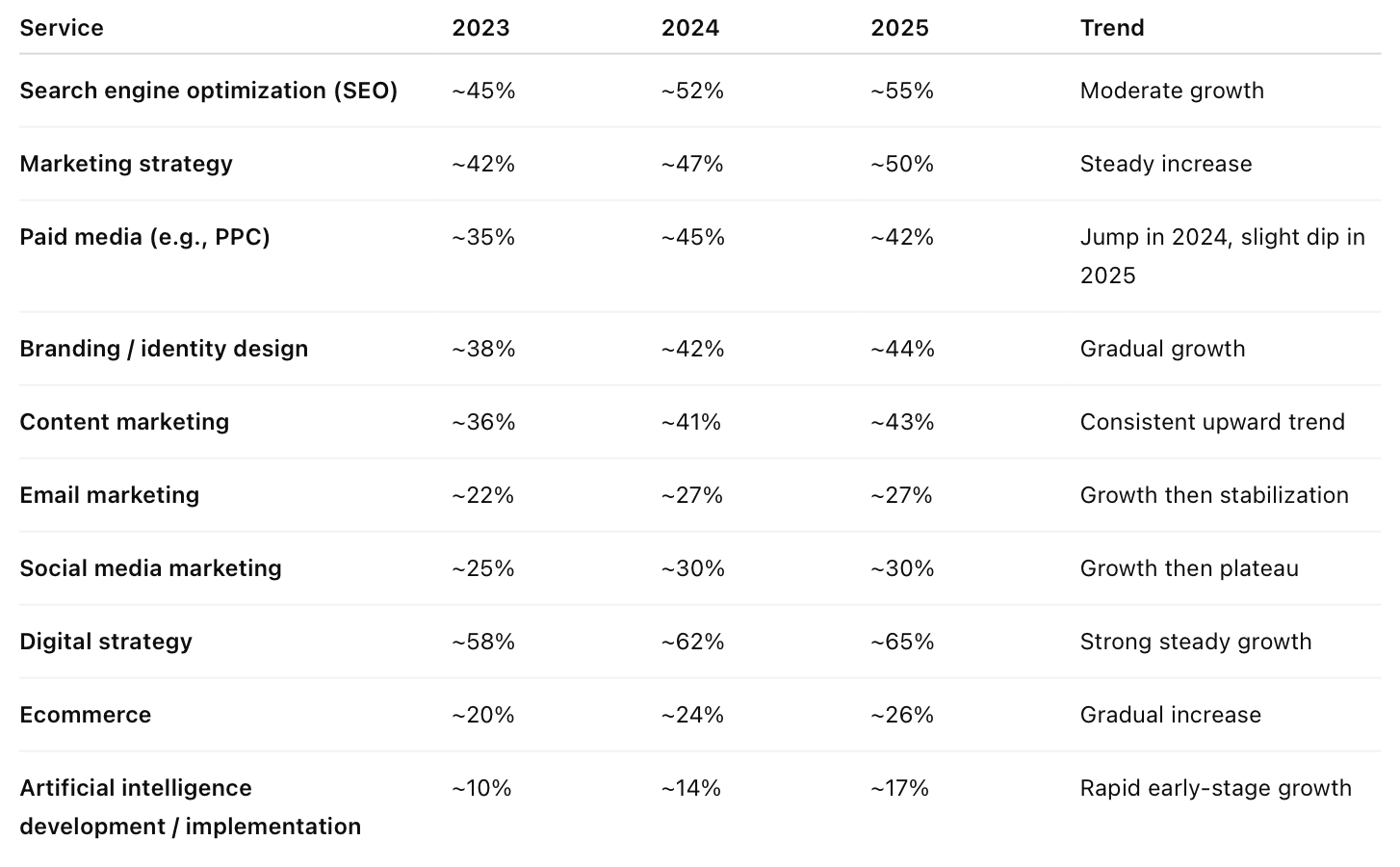
Between 2023 and 2025, digital marketing agencies increasingly diversified their offerings. AI-driven solutions expanded rapidly—from 10% to 17%—as some firms began integrating marketing automation, analytics, and ad targeting into their workflows.
SEO and paid media spiked in 2024, reflecting a resurgence in performance-focused marketing, while marketing campaigns incorporating branding and content marketing saw gains of 4% to 6%.
Digital marketing strategy saw a steady increase from approximately 42% in 2023 to about 50% in 2025, and ecommerce for agencies managing online sales performance experienced a gradual increase from about 20% to 26%.
Paid media, such as PPC, spiked 10 points from 35% to 45% in 2024, but decreased slightly to 42% in 2025.
Meanwhile, email marketing and social media marketing on platforms such as TikTok, Instagram, and YouTube climbed 5 points by 2024 before leveling off, highlighting a strategic shift toward owned, direct-response channels as acquiring new customers became more expensive.
Here’s the full breakdown, from Promethean Research’s 2025 Digital Agency Industry Report:
Source:
Promethean Research.
6. Digital marketing job growth is expected to increase 6% by 2032, higher than the average
According to the Bureau of Labor Statistics, the job outlook for marketing, advertising, and promotions managers is predicted to grow faster than the national average, with jobs increasing 6% over the next 10 years.
In 2024, there were 434,000 jobs in this category, and the bureau expects growth of 26,100 jobs over the next decade, for a projected 460,100 jobs in 2034.
For agencies, this growth is driven largely by consumer behavior: 76% of people now browse and buy directly on social media platforms, and there are 4.89 billion social media users worldwide, including more than 1 billion on LinkedIn.
Source: Bureau of Labor Statistics, Forbes.
Digital Marketing Agency Growth Statistics: What’s Driving Growth?
Increasing online advertising budgets, ad spend, and a growing digital marketing market are key drivers of growth among digital marketing agencies.
7. Annual 10% growth in U.S. ad spending continues to drive demand for digital marketing agencies
The U.S. digital advertising industry grew 10% in 2024 to reach $53.6 billion. Continued growth at this pace—projected to hit $94.97 billion by 2030—reflects expanding client budgets that fuel agency growth and competition.
Source: IBISWorld.
8. U.S. digital ad spend will reach $324.9 billion in 2025, creating more work for agencies
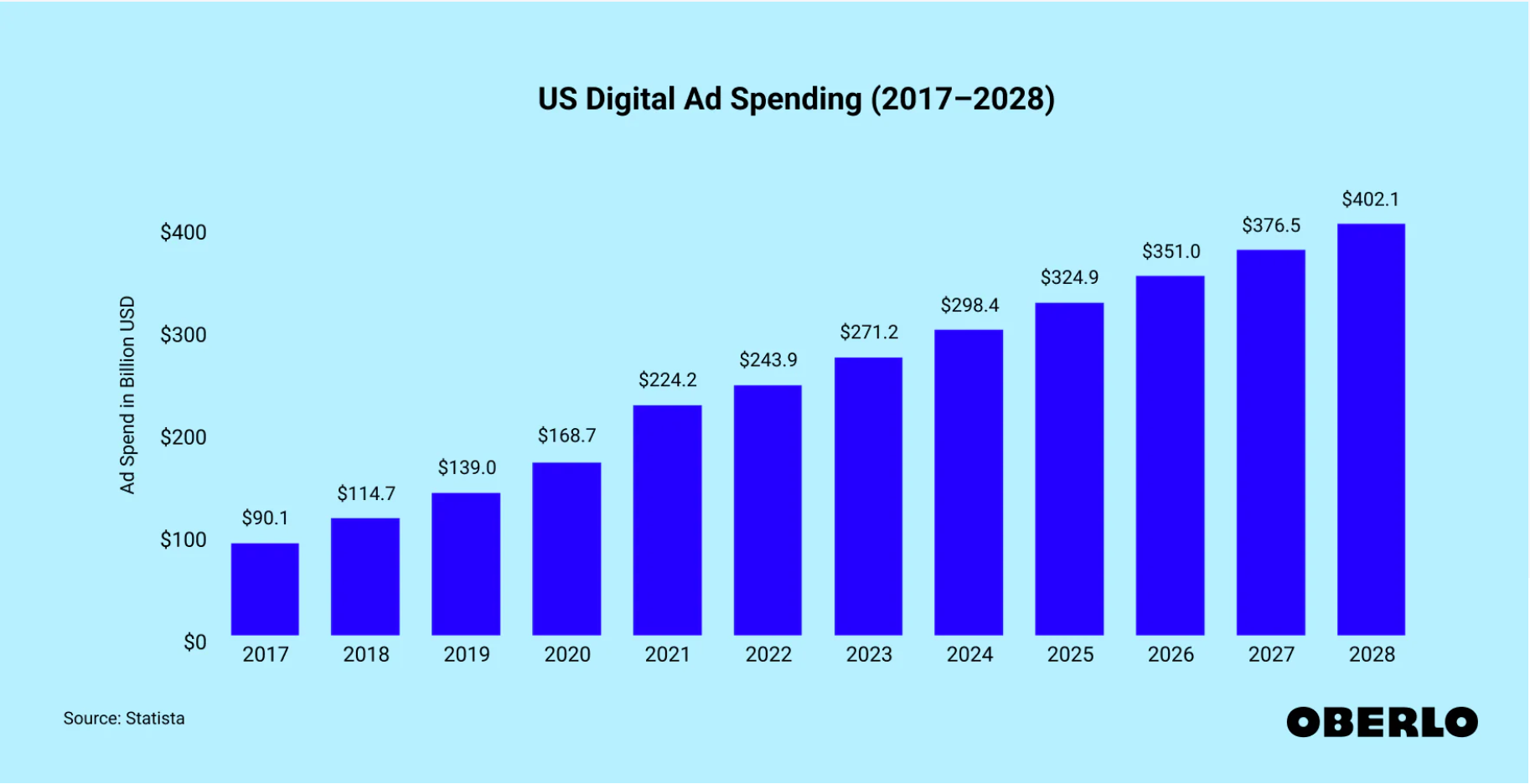
U.S. digital ad spending is set to surpass the $300 billion milestone in 2025, reaching $324.9 billion—an 8.9% increase from $298.4 billion in 2024. This marks a slowdown from the 10% year-over-year growth seen in 2023, when spending totaled $271.2 billion, but growth continues to boost opportunities for digital marketing agencies.
From 2026 to 2028, digital ad spend is forecast to climb to $351 billion, $376.5 billion, and over $400 billion, respectively. However, overall growth from 2024 to 2028 is expected to moderate to a 7.7% CAGR, roughly half the pace of 2020–2024, when annual growth averaged 15.7%.
Advertising spending per U.S. internet user will exceed $1,000 in 2025—nearly triple 2017 levels—reflecting continued advertiser investment across digital channels.
9. Globally, the digital marketing market will grow to $1,099.33 billion by 2032, at a CAGR of 13.1%
10. The U.S. digital marketing market reached $410.7 billion in 2024—illustrating expanding budgets that agencies manage and capitalize on
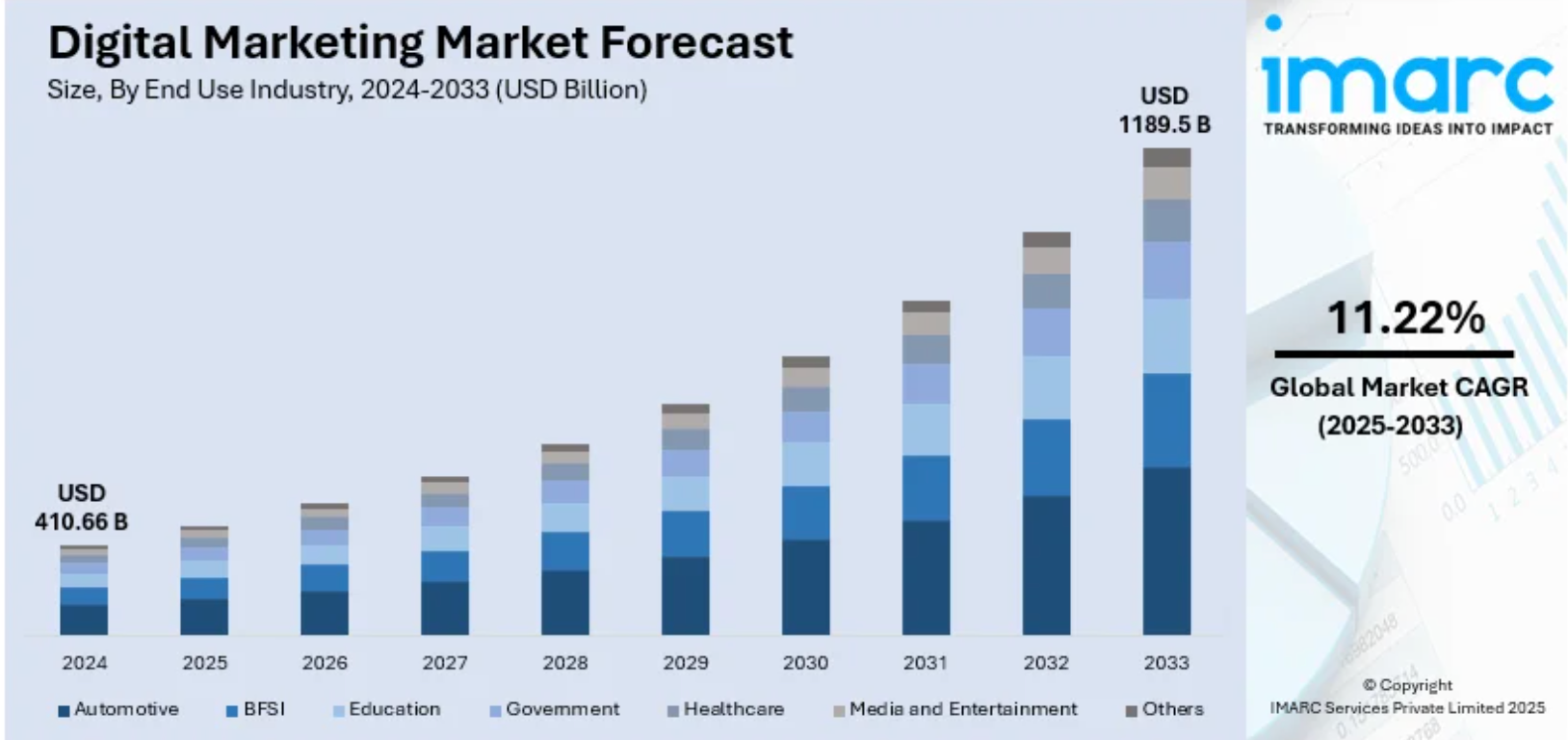
The global digital marketing market is projected to grow from $410.66 billion in 2024 to nearly $1.19 trillion by 2033 at a 11.22% CAGR.
As overall digital marketing budgets rise, agencies are poised to benefit from increased client demand, bigger campaigns, and more service opportunities.
What These Digital Marketing Agency Growth Statistics Reveal
- Market size is expanding quickly, with global and U.S. digital marketing spend projected to continue rising—creating new revenue opportunities for agencies.
- SEO, digital strategy, and AI-related services are among the fastest-growing offerings, signaling the importance of becoming more data-driven in service delivery.
- Client budgets are increasing in digital channels, especially paid media and social platforms—suggesting agencies should strengthen their paid advertising expertise.
- Agencies are scaling up, with a growing number now employing 10–50+ full-time staff; this reflects increased demand and the operational need for specialized roles.
- To capitalize on these trends, agencies might invest in influencer marketing, video content, or short-form video campaigns to reinforce social media performance, or use AI tools to improve efficiency and reporting.
- These insights also connect to key performance areas like conversion rate, website traffic, CTR (click-through rate), and rankings in organic search, which can help agencies demonstrate high-quality outcomes, reach target audiences through the right marketing channels, and achieve the highest ROI (return on investment) for clients.
- As the marketing landscape evolves, strategic partnerships, strong pricing models, and focusing on small businesses or niche verticals can help agencies expand market share while maintaining sustainable growth.
How Agency Designs Can Help
As the digital marketing industry grows, agencies are under pressure to expand services, deliver results faster, and stay competitive. But scaling often requires more time and resources than teams have available.
That’s where Agency Designs supports your growth. Our white-label design and production system enables agencies to deliver professional, conversion-focused websites faster without adding internal overhead.
Focus on strategy and client relationships while we handle execution.
Schedule a demo today to see how we help agencies scale smarter.